
Generative AI continues to work its way into K–12 classrooms. In fact, it’s being integrated so quickly that school policies and research about best practices with AI are struggling to keep up.
The following survey of current research was generated using ChatGPT and Gemini Deep Research. The Deep Research tool develops a research plan based on a user prompt and then conducts an iterative, in-depth search of available online or uploaded resources in order to answer the question or satisfy the prompt request.
Much of the content in this article is based on results to the following Deep Research prompt: “Act as a K–12 educational research expert. Research best practices in using generative AI in K–12 schools. Focus on U.S. schools during the past two years. Generate a list of the top 10 most popular and effective strategies.”
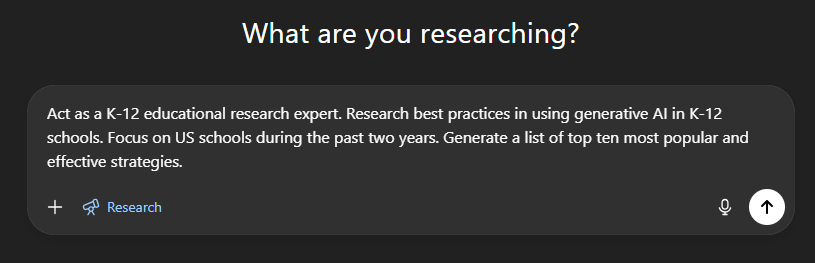
The content was generated from a list of over 200 sources discovered through the two Deep Research queries and is intended to provide K–12 educators with a list of the most popular and effective practices in the use of AI. The generated list serves as an awareness tool and potentially as a reference point for teachers in determining goals and next steps for their use of generative AI.
Teacher Uses
The most common use of generative AI by teachers is for tasks that save them time.
1. Differentiation and Scaffolding
Teachers use AI to instantly generate leveled texts, customized graphic organizers, translations, and vocabulary supports. This use is effective, as it improves accessibility and comprehension for diverse learners.
2. Resource Generation
This is similar to differentiation and scaffolding, but it’s broader and also involves streamlining administrative tasks, such as individualized education programs (IEPs), lesson plans, and content outlines. These tasks can be done with generative AI chatbots like ChatGPT and Gemini, and they can also be facilitated with third-party tools like MagicSchool and SchoolAI.
3. Assessment Generation
Teachers frequently use AI to help create test questions, align quizzes, and put together diagnostic reports. This streamlines the time-consuming process of grading and also provides insights to guide data-driven instruction. When used to create formative assessments, it also provides valuable practice opportunities for students in the form of self-grading quizzes and flash cards that give immediate feedback.
Student Uses
While teacher-centric practices are important and can free up valuable time to work individually with students, the student-facing strategies are the ones that have the most potential for transforming the actual learning experiences.
This is also where the majority of the Deep Research results are focused. The following are the top student-facing strategies that were highlighted as effective approaches in the research.
1. AI-Powered Tutors
This is a top strategy that appears on both the Gemini and ChatGPT lists.
Tutoring is one of the most impactful approaches that we can implement in the classroom. It’s also time-consuming and resource-intensive. The introduction of generative AI into the equation has made one-on-one tutoring more realistic and scalable.
ChatGPT cited an Edutopia article written by Daniel Leonard, AI Tutors Can Work–With the Right Guardrails. AI-powered tutors mimic the benefits of one-on-one instruction, adjusting to student needs, providing step-by-step hints, and prompting deeper thinking.
Studies cited in the article point out that students using the guided AI tutor scored dramatically higher on practice problems without harming performance on real tests. Teachers also report higher engagement and motivation when students use these tutors to explore material at their own pace.
2. Differentiated Learning Materials
This item is a win-win, as it’s a practice that ties back to one of the time-saving strategies for teachers. Not only does AI help save time and make differentiation more feasible, it also has a positive impact on student learning, removing barriers by improving student access to content at an appropriate level.
3. Automated Feedback
Feedback is key to the learning process. Students need to know whether they’re on the right track, so they can make the necessary changes to improve. Feedback is also one of the most time-consuming tasks that a teacher faces each day. Tools like MagicSchool and SchoolAI have developed student-facing AI tools in their ecosystems that provide automated feedback to students on their work, often shaped by teacher input during the design phase of the process.
EnlightenAI is another product that is gaining popularity, as it provides writing feedback and acts as a formative assessment tool. It isn’t intended to replace the teacher, but rather, it helps to make timely feedback on writing more efficient and realistic. In fact, the teacher plays an active role in training the AI.
4. Interactive Role-Playing via AI Chatbots
In some ways, this is like automated feedback in the form of a character or historical figure.
Teachers can leverage prompts to direct chatbots to take on personas and carry on conversations with students. Tools like Khanmigo and MagicSchool include premade experiences that teachers can share with students, and they require very little work to set up.
Engaging with these personas is both engaging and insightful. For instance, history and language students can now speak with Thomas Jefferson about the Declaration of Independence or chat with Atticus Finch, the lawyer in To Kill a Mockingbird. World language teachers can use this as a way for their students to have conversations with the chatbot in a language that they’re studying for helpful practice.
While these experiences may occasionally hallucinate and communicate incorrect content, they are generally on target and can provide a safe and feedback-rich learning opportunity for students.
5. Project-Based Learning
Rather than banning AI, many teachers are redesigning assignments to incorporate generative AI as a tool in the process. By doing so, they are in some ways “AI-proofing” their assignments and assessments.
Two keys to success are to target authentic learning opportunities and to help students then define and understand the steps in that process where AI both fits and is acceptable.
To foster transparency, some teachers will have students document when and how they use their AI partner during the process. Tasks that are often targeted include drafting, generating, and revising content in repeated cycles, with the student as the active creator.
6. AI-Assisted Writing and Revision
This strategy has caused concern among some teachers, especially writing teachers.
They wonder, how do we make sure that students are still learning to write on their own while also empowering them with the skills and knowledge about how AI might help in the process? There is no perfect answer to this question, with many teachers still trying to figure out how to use it in their own writing.
In many cases, teachers help students to identify which tasks in the writing process are AI-friendly and which should be done without the use of generative AI. A big part of that involves open and honest communication. It also means providing examples and guidance, such as how to use AI to spark ideas and suggest improvements.
Sample prompts can be shared with students to help guide this process.
7. AI Literacy and Ethics Exercises
Many teachers have realized that they need to help students learn how to navigate and use generative AI, both for the sake of academic integrity and to help them become knowledgeable and skilled users of generative AI inside and outside of the classroom. Students need to know how AI works, its limitations, and how to use it effectively and responsibly.
Tools like AI Trust You from the Laguna Beach Unified School District and free resources from organizations like News Literacy Project and Common Sense Media are available to help guide teachers through this process.
Which strategies from the list have you tried, and which are areas that you could still explore? Are there any areas of generative AI use that you haven’t tried that might potentially save you time and improve student learning? If the answer is yes, pick one, dig in, and give it a try.
AVID Connections
This resource connects with the following components of the AVID College and Career Readiness Framework:
- Instruction
- Relational Capacity
- Rigorous Academic Preparedness
- Opportunity Knowledge
- Student Agency
- Insist on Rigor
- Break Down Barriers
Extend Your Learning
- Gemini Deep Research (Google)
- Best Practices in Generative AI for US K–12 Schools (2023–2025): A Synthesis of Adoption and Efficacy (Gemini Deep Research)
- Introducing Deep Research (OpenAI)
- Top 10 Generative AI Instructional Strategies in K–12 Education (2023–2025) (ChatGPT Deep Research)
- Human-Centered AI Guidance for K–12 Public Schools – Implementing AI: A Practical Guide for the Classroom (Washington Office of Superintendent of Public Instruction)