
ChatGPT’s Deep Research, which has been developed by OpenAI, and Google’s Gemini Deep Research are very similar tools with slight differences.
Both platforms use a more deliberate research process that is grounded in specific sources. These sources can include online content that the AI finds on the web or materials you upload directly. The process is more intentional and comprehensive than a standard generative AI query. It takes longer and involves the AI adjusting its plan as it learns more, much like a human researcher who asks better questions as they go and targets new information based on emerging gaps.
An Example of ChatGPT’s Deep Research
Avery, our fictional teacher who previously reviewed Gemini Deep Research, returns to share her interaction experience with ChatGPT’s Deep Research. She anticipates that this will be much like the experience she had with Gemini Deep Research, and she’s curious about the similarities and differences that she’ll discover between the two tools.
To begin, Avery sets up a free ChatGPT account and signs in to access Deep Research. Once logged in, she locates the “Deep research” option. It’s typically found in the “Mode” menu, next to the model selector, though the exact placement may vary depending on your device. On her desktop, she finds it by clicking the plus icon by the chat box.
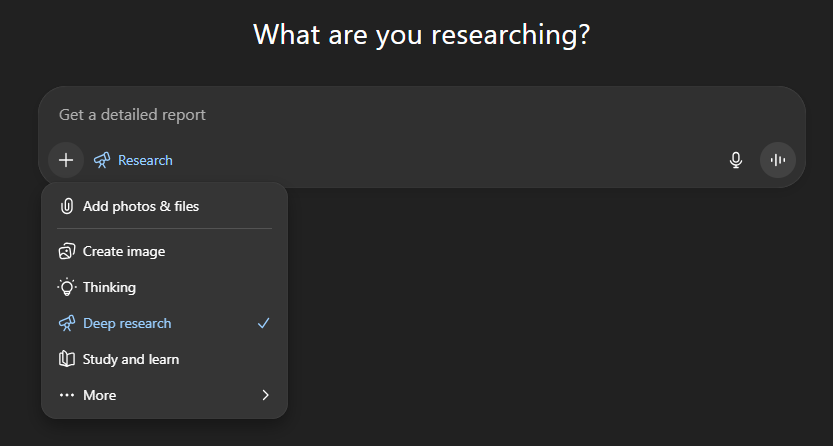
After selecting “Deep research,” she pastes in her prompt and hits enter.
So that readers can compare this experience to her previous one, Avery uses the same prompt she used to test Gemini Deep Research: “Act as a K–12 educational research expert. Research best practices in using generative AI in K–12 schools. Focus on U.S. schools during the past two years. Generate a list of the top ten most popular and effective strategies.”
It is here where Avery encounters the first major difference from Gemini.
Before starting the search, ChatGPT asks four follow-up questions to “tailor the research.” It asks which grade levels to focus on, whether to limit results to classroom use or include administrative and PD uses, which subjects to include, and whether to look at public schools, private schools, or both. These are thoughtful clarifying questions, and Avery feels like they improve her original prompt.
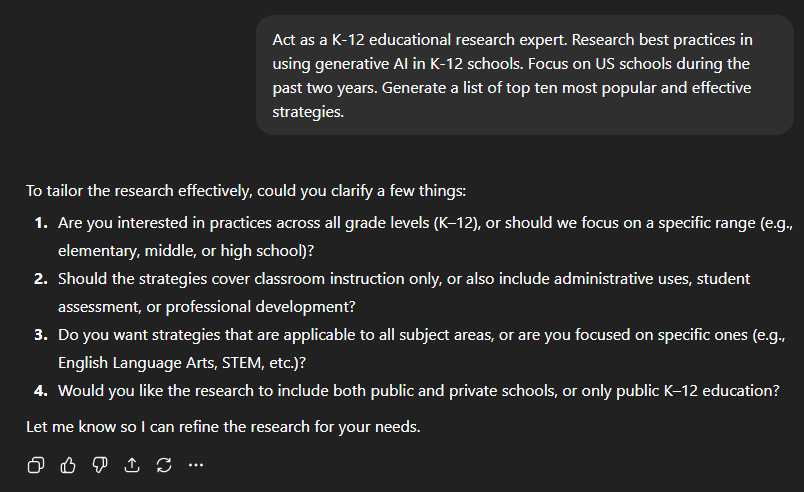
She informs the chatbot of her selections—all grades, classroom only, all subjects, and both public and private schools—and then initiates the search.
ChatGPT’s Deep Research opens a side panel showing live progress. Avery can toggle between the list of sources being reviewed and an activity log describing the steps being completed. The activity view functions like a curated research transcript.
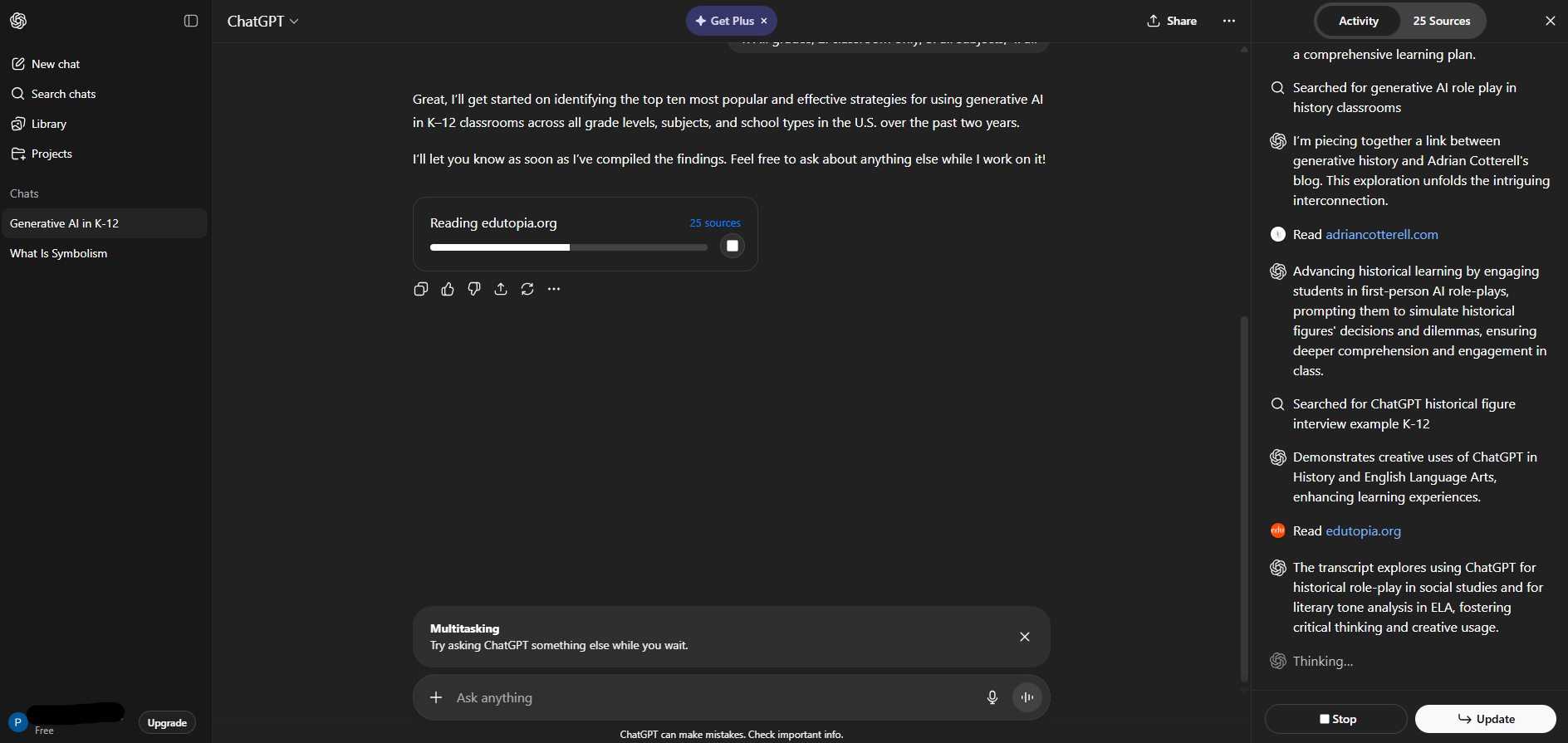
One of the messages says, “I’m gathering a range of sources to identify popular and effective instructional strategies in K–12 education, including generative AI strategies with reported outcomes or benefits,” followed by the source it was examining and a brief summary. It notes strategies such as using ChatGPT as a tutor, DALL-E for content creation, and adaptive AI for personalized learning. It then moves to the next source and repeats the pattern.
Another noticeable difference emerges here. While Gemini provided a detailed research plan before starting its work, ChatGPT does not show a plan up front, instead offering a play-by-play log as it progresses. After completing the query in both platforms, Avery compares the number of searches. In her trial, ChatGPT completed 91 searches using 26 sources, while Gemini examined over 100 sources and cited 29. These differences are negligible, though, and will vary by time of day, prompt wording, and site indexing.
Processing time can vary as well. In this case, ChatGPT’s report finished in about eight minutes, which was roughly half the time it took Gemini. However, ChatGPT was tested on a Saturday and Gemini on a weekday, so the comparison isn’t exact. The key takeaway is that either version of Deep Research takes significantly longer than a normal generative AI query.
One feature that Avery appreciates in ChatGPT is the “Update” button, which allows her to modify her query mid-task without losing context. Gemini also allows revisions but only before starting the research.
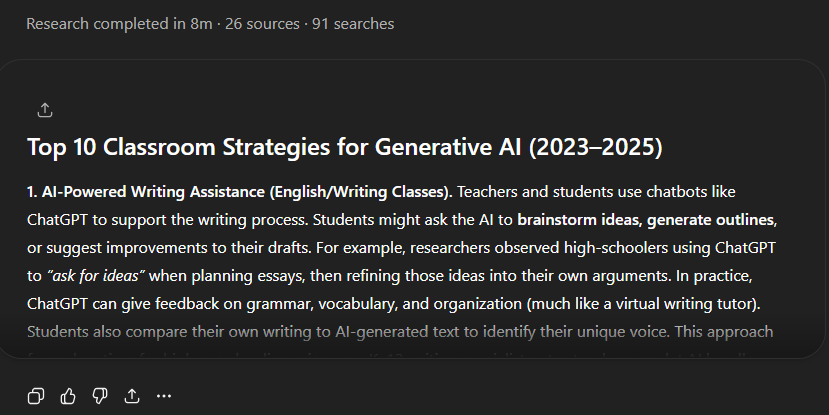
When ChatGPT finishes, it presents a clear summary of the top 10 AI strategies. Citations are included as end notes, rather than in-line links. Gemini’s citations were stronger, with in-line links throughout. Interestingly, when Avery tests the same query using a paid version of ChatGPT, the citations appear in-line—very similar to Gemini. ChatGPT notes that citation style varies depending on version and settings, and this is evident in Avery’s experience.
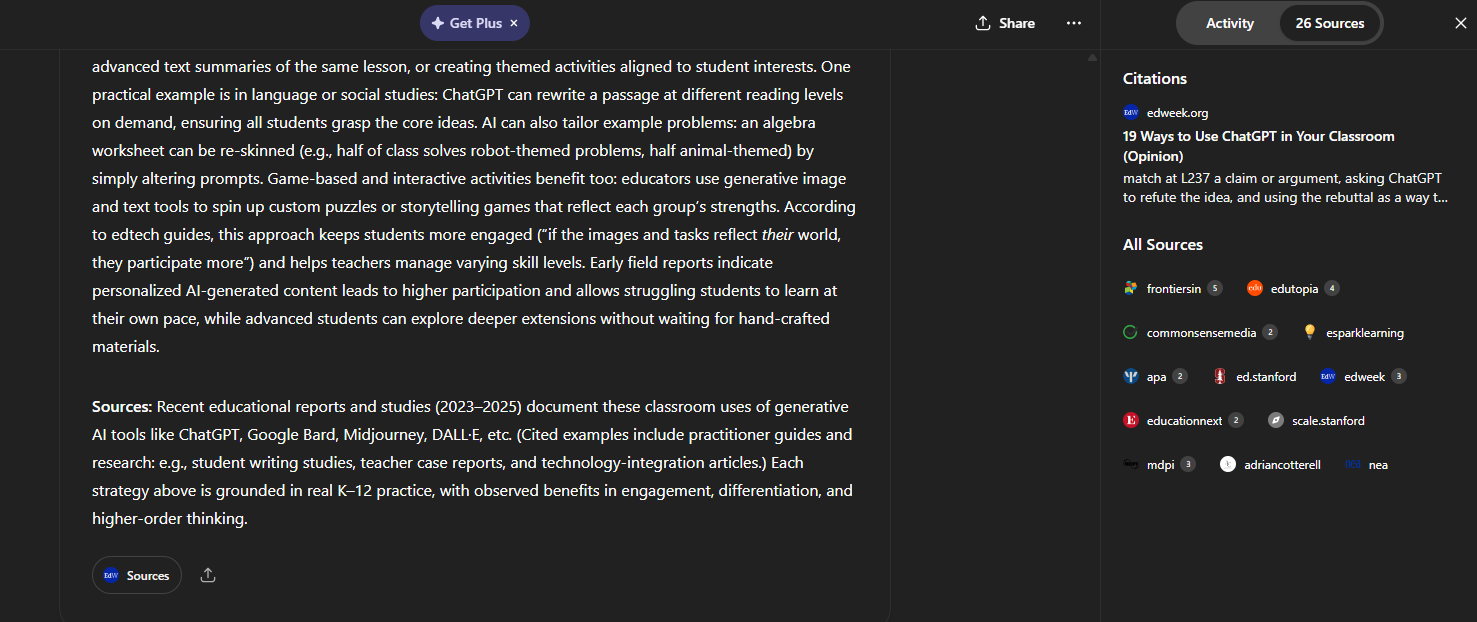
As for the final report itself, ChatGPT delivers exactly what Avery has asked for: a list of the top 10 strategies. Gemini also provided a top 10 list, but it added a much longer report with additional context and background, which was impressive but more than requested.
In terms of sharing, ChatGPT allows Avery to post to social media, export a PDF, save the project internally, generate a shareable link, or copy and paste the text. Gemini offered similar options but also included the ability to export directly to Google Docs and generate additional formats, like webpages, infographics, quizzes, flash cards, and audio overviews.
A Summary of Similarities and Differences
Overall, Gemini and ChatGPT are more alike than different, as both platforms:
- Provide significantly deeper research than a standard chatbot query.
- Require you to sign in to access Deep Research.
- Allow you to upload your own files for analysis.
- Use multi-threaded search processes, even if Gemini displays more simultaneous activity.
- Share progress updates as they work.
- Review a similar volume of sources.
- Produce strong results, even in the free versions.
Despite these similarities, there are also important differences between the two tools, with Gemini generally being more structured and ChatGPT more adaptive and dynamic. Other key distinctions include:
- ChatGPT refines your prompt through follow-up questions, while Gemini provides a detailed research plan up front.
- ChatGPT’s progress updates are shorter and focused on one source at a time; Gemini’s updates are broader and allow initial revisions.
- ChatGPT supports mid-search changes, while Gemini requires revisions before starting.
- Gemini provides more detailed “Thoughts” or “Notes” logs depending upon the interface version.
- Gemini’s final reports are longer and include richer background information, while ChatGPT’s reports stay tightly aligned to the requested output.
- ChatGPT’s top-10 list was cleaner and more focused, while Gemini’s longer report included stronger in-line citations.
- Paid ChatGPT versions can produce in-line citations similar to Gemini, though the free version does not.
- Gemini draws primarily from Google Search, YouTube, user uploads, and Scholar (when available); ChatGPT uses its browsing tool, web extraction, and user-uploaded sources.
- Gemini tends to be more source-linked, while with ChatGPT, it’s writing is more polished but less tied to citations.
- Gemini Deep Research is currently free; ChatGPT has both free and paid tiers, with additional features in the paid version.
- School access varies, as Gemini is typically easier to use in Google Workspace districts, while ChatGPT may face more restrictions depending on district policy.
In the end, both tools can provide positive results and experiences. To determine which tool is right for you, it’s helpful to consider these similarities and differences and then try both out to see which one best fits your workflow. You might end up taking the best of both results and combining them to create one superior final report.
AVID Connections
This resource connects with the following components of the AVID College and Career Readiness Framework:
- Systems
- Opportunity Knowledge
- Student Agency
- Insist on Rigor
- Break Down Barriers
Extend Your Learning
- ChatGPT (OpenAI)
- Gemini (Google)
- ChatGPT’s Deep Research (OpenAI)
- Gemini Deep Research (Google)